
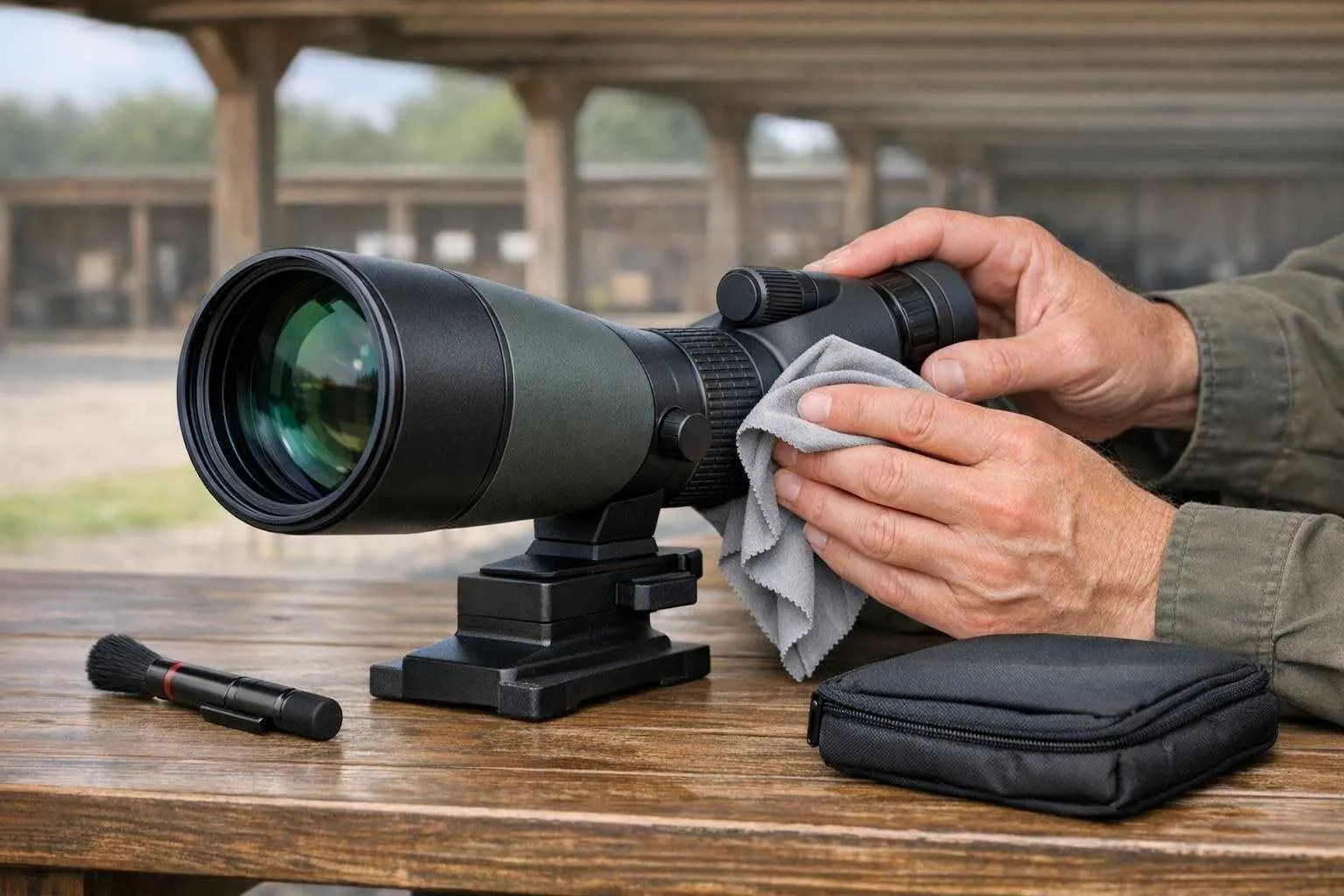
But a single missing staple, a dirty spotting scope or a heap of used-up gun cleaning patches can cause quite a commotion. And so it is with shared club equipment: only when each user has left the other's equipment in good and serviceable order can the system function well. That means inspect what you use, clean only what you know how to, report any damage to the appropriate person, and generally leave the bench as you found it.
Start with a quick condition check
Inspect what you use before you move shared range equipment. Look for cracks in lenses, loose screws, missing parts, broken cables, faulty gun rests or dirty residue that could transfer to firearms or optical equipment. A simple inspection for obvious damage before you move shared range equipment can save a lot of problems later.
An empty packaging, old spent patches, loose screws, or personal items are easily mixed up with rubbish on a dirty bench. First clear the bench of all club property, and then sort out the rubbish from the other items. Don't throw away old or unknown items in the range. Ask the range officer or hand them over to the appropriate person according to the club's normal procedure.
Same for apparently clean range equipment. Yes the tripodal support for your spotting scope might look fine but can be stiff to adjust. And yes the magazine loader you use might work but its parts must be kept together. While many things that deteriorate slowly need not be fixed before they deteriorate further, every problem that affects safe use, reliable function, clean use or the basic purpose of a piece of shared range equipment must be reported.
Clean the parts you are qualified to clean
Shooting range equipment cleaning must simply restore the configuration to be able to be used again by others. The simplest method of cleaning (using the supplies provided at the club for example) would be to wipe any dust and grime from surfaces such as stands, rests, tables, and cases. Liquids must NOT be used to clean electrical components, lens surfaces, and the interior of firearm openings for example. Simply use the correct cleaning method for lens surfaces for example, and use the recommended cleaning method for other components.
Clean those parts that you know how to clean properly, and make sure to refer to the maker's instructions when cleaning internal parts of firearms. Sling straps, shooting bags, gun rests, and spotting scopes can be wiped down with cleaning solutions and clothes, but it is important to always refer to the proper cleaning methods for lenses and other optical surfaces. All other parts and accessories of a firearm should not be modified in any way to attempt to fix a temporary problem. Tape, lubricant, spacers made out of any material other than the recommended type, and altered fasteners can all create new problems that could potentially be worse than the original dirt or damage.
While cleaning a scope's lens it is better to follow the manufacturer's instructions on cleaning than to risk smearing dirt around using your shirt or a dry paper towel. Also, be careful when cleaning rests and supports. Remove any visible debris but don't force any parts that seem to be locked in place. It's better to leave a bit of dirt behind than to risk damaging the part in some way.
Leave the station neutral, not merely empty
Clear your bench of your own trash, pick up your targets and packaging, and even check the floor for lost items of your own before leaving the bench. Your bench must be left in a neutral state – i.e. returned to how you found it -, ready for the next shooter.
Leaving shooting gear in arbitrary positions for other's use can be just as problematic as leaving a messy workbench. All shared range equipment should be put back in a neat and organized manner so others can easily see how to set up for a similar shot. Note that returning an item to its original factory settings is not required.
Resetting equipment differs to hiding broken items. Damaged items may appear to be clearing space but would be better marked for the owner or for disposal via the club's normal process. Simply setting an item aside with a note such as 'Right adjustment knob sticking' is far better than classing it as 'broken'.
Treat etiquette as a safety system
Etiquette should also be treated as a safety function on the range. Empty any trash and keep walkways clear. Make sure that all of your equipment has been cleared from your firing line before going to retrieve any targets or range gear. Also do not reach across an active workspace of another person. Be very cautious when approaching the firing line of another person. Wait for instructions from the range officer before leaving the firing line or collecting your equipment.
Remember not to pass items across a firing line or handle shared equipment while another person is shooting with a loaded firearm. Communicate with others before moving a camera rest, range bag or scope to clean it at another shooting position. Remember also to clean items in non-intrusive places and avoid placing cleaning liquids, rags and other items that may be washed away by cleaning sprays in others' working areas.
Shared equipment must be cleaned and put away as one would wish someone else to treat it and, when it breaks, reported, replaced or left alone as the club's procedure dictates. The range's local rules and the club's policies regarding range use will vary from place to place and must be adhered to as laid out in the club's procedures and the official guidance.
Decide when to report, replace or leave alone
Replace consumable items for shared equipment when the club has made supplies available for member use. Do not try to 'make do' by using a spare from another bench. Report missing items rather than use an alternative and risk leaving another member with an incomplete set of equipment.
Only report a defect if it affects the safe use, correct function, cleaning or main use of the item. Quote the location of where you found the item and give full details of the fault, i.e. the clamp on a columned camera support slips under light pressure. Do not attempt to diagnose a problem with a piece of equipment and then state what repairs are needed. If in doubt, do not touch it.
Yes, some minor problems can be sorted but it's crucial that you do not 'mend' anything that falls outside of your capabilities or the club procedures. Most notably, if a fault involves a firearm, electrical item, damaged optic, etc. then it's better to seek assistance than risk causing an accident.
Make the next visit easier
The best shared range equipment is not something which has been left unchanged but which has been quietly taken away. It is something which has been left in a clear state of deterioration or has been cleaned and the remnants of previous users cleared away. A clear bench, a complete piece of range equipment left in an intact state, a returned to original setting item, and an honest report of a fault all make the next user's life a lot easier than if they had been left in an unclear or chaotic state.
Turning good range culture into practice does not have to be hard to do. The following things need to be done before you use something. Clean up as much as you can, collect up loose parts of equipment, follow the range officer's instructions and let others know what they need to know about the gear you have left behind.